
TV Signal Dropping Out in Sydney? Causes, Checks & Common Fixes
A TV that keeps pixelating, freezing or suddenly displaying “No Signal” usually has a reception problem somewhere between the broadcast transmitter and the television.
The problem may be as simple as a loose cable or incorrect tuning, or it may involve the rooftop antenna, cabling, splitters, an amplifier or local interference.
- Why digital TV suddenly pixelates
- Quick TV reception diagnosis
- 6 common causes of TV signal dropouts
- Safe checks you can do yourself
- How Sydney location can affect reception
- Repair or replace the antenna?
- What TV reception repairs can cost
- What professional testing should check
- Australian cabling requirements
- Quick summary
Why digital TV can suddenly start pixelating
Digital television behaves differently from older analogue television. Analogue reception could gradually become snowy or fuzzy as signal quality deteriorated.
Digital television can continue looking normal while the available signal margin becomes smaller. Once reception becomes too weak or unstable, the picture may suddenly break up.
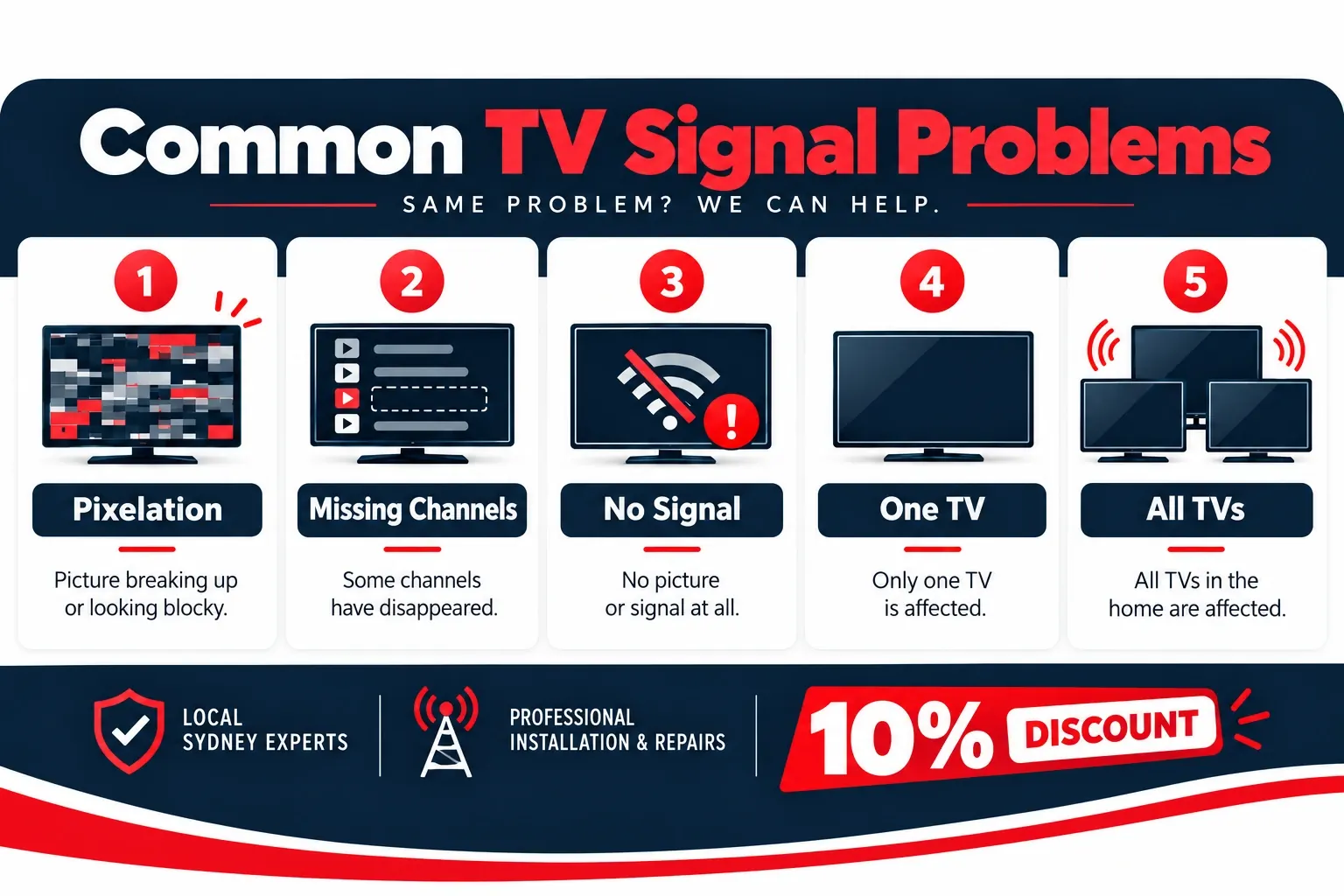
Typical symptoms include:
- blocky pixelation
- picture freezing
- broken or distorted audio
- channels disappearing
- “No Signal” messages
The ABC lists pixelation and “No Signal” among common symptoms of poor or unstable television reception and recommends checking whether the problem affects all channels or only particular services.
View ABC television reception guidance
Quick TV reception diagnosis
| What you see | Possible cause | First check |
|---|---|---|
| Pixelation or freezing on most channels | Weak or unstable signal, cable loss or antenna fault | Check another TV |
| Only some channels are missing | Tuning issue or reception problem affecting certain frequencies | Check tuning once |
| “No Signal” after strong wind or a storm | Antenna movement, damaged cable or damaged mounting hardware | Check whether other TVs are affected |
| Only one television is affected | Fly lead, outlet, television tuner or local connection | Swap the fly lead or television |
| Reception drops at particular times | Interference or marginal signal conditions | Record when it happens |
| Every TV loses reception at once | Amplifier, splitter, antenna or main cable fault | Signal testing may be required |
| Problems mainly during rain | Water entry or marginal reception | Inspect indoor connections only |
The 6 common causes of TV signal dropouts in Sydney
1 The antenna has moved, deteriorated or been damaged
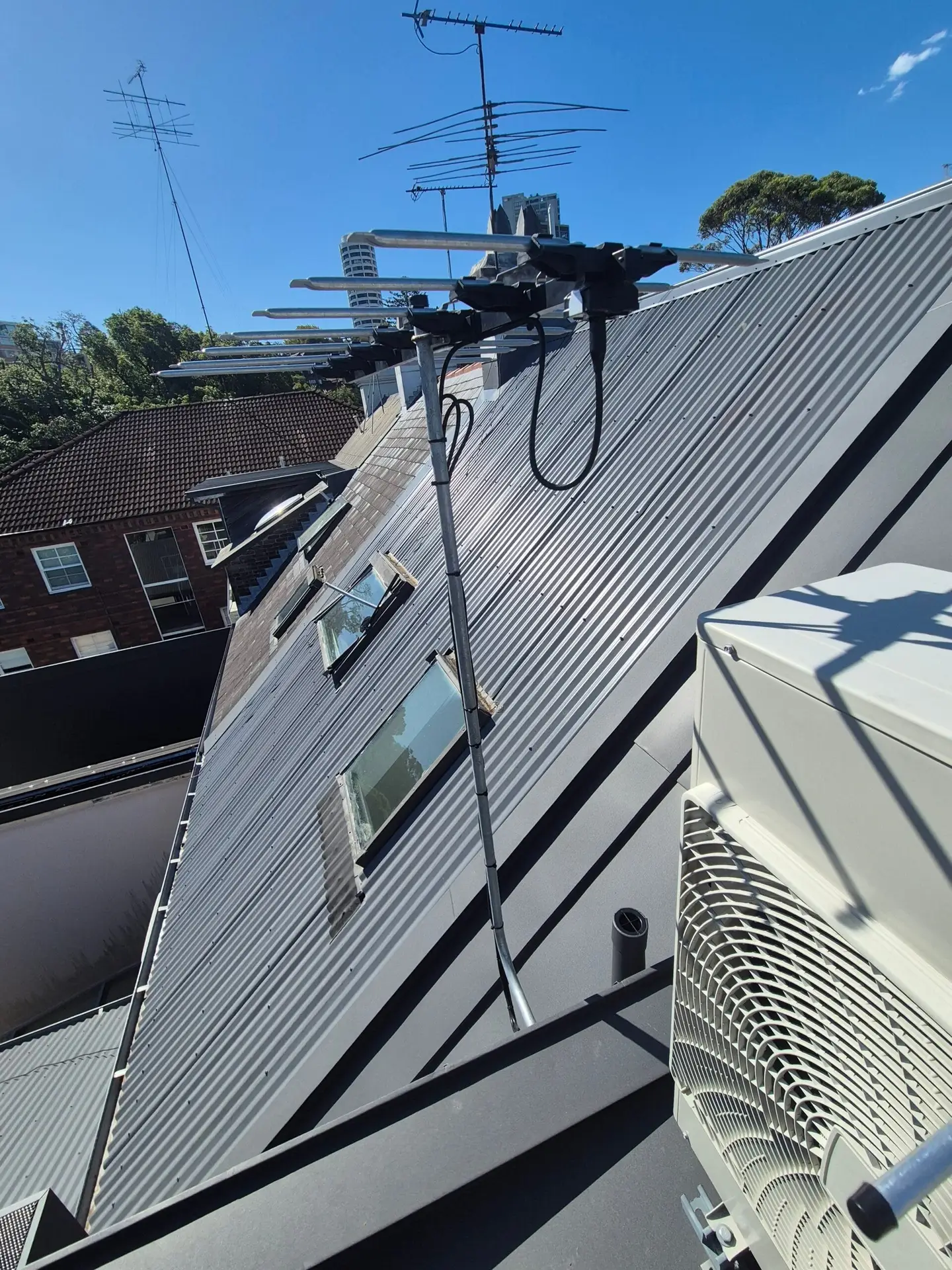
A rooftop television antenna needs to be aimed and configured for the transmitter that best serves the property.
Antenna direction should not simply be copied from the house next door. Terrain, surrounding buildings, the transmitter serving the address and the antenna installation itself can all affect performance.
The Australian Government’s mySwitch digital TV tool can provide predicted reception information, available transmitters, frequencies, antenna direction and orientation for an address.
Wind, roof work, deteriorated brackets and physical damage can alter antenna alignment. Corrosion or broken antenna elements can also reduce performance.
Even a relatively small alignment problem can cause unreliable reception when the available signal margin was already low.
2 Corroded connectors or damaged coaxial cable
The antenna itself is only one part of the reception system.
A typical signal path may include:
- the rooftop antenna
- connectors
- coaxial cable
- splitters
- amplifiers
- wall plates
- the television fly lead
One poor connection can affect the performance of the whole system.
Outdoor connectors are exposed to heat, rain and moisture. Poor weatherproofing can allow moisture into a connector or cable, gradually reducing signal quality.
Common warning signs include:
- green or white corrosion
- brittle or cracked coaxial cable
- loose connectors
- damaged fly leads
- intermittent reception when weather changes
- reception that has gradually become worse
Replacing a faulty connector or damaged cable section can sometimes restore reception without replacing an otherwise serviceable antenna.
3 Too many splitters or a problem with the amplifier
Every time a television signal is divided between multiple outlets, some signal loss occurs.
A multi-TV installation may contain splitters, multiple cable runs, wall outlets, masthead amplifiers or distribution amplifiers.
None of these components should automatically be blamed. A stronger amplifier is not automatically better either.
If the incoming signal is already poor, distorted or affected by interference, simply amplifying it may amplify the problem as well.
For information about additional outlets and television distribution, see Foxtel & TV Point Installation Sydney .
4 Interference
Interference can create symptoms that look similar to a weak signal.
ACMA identifies both reception faults and interference as possible causes of television reception problems.
Useful clues include whether reception deteriorates only in the evening, when particular electrical equipment is operating, during certain weather conditions, on particular channels or at regular times.
Do not automatically assume every dropout is caused by 4G or 5G. Proper testing should identify whether interference is actually present before filters or other components are installed.
5 Weather, moisture and exposure
Sydney has very different exposure conditions from suburb to suburb.
A sheltered home in Western Sydney does not experience exactly the same environmental conditions as an exposed rooftop close to the coast.
Wind, UV exposure, moisture and salt can accelerate deterioration of antenna elements, mounting brackets, bolts, outdoor connectors and exposed coaxial cable.
Weather can also expose a reception system that was already operating close to its usable signal threshold.
6 The television needs to be retuned
Not every missing channel means the antenna is faulty.
A television’s stored channel list can occasionally become outdated or incorrect, and retuning may resolve the issue.
Before repeatedly running automatic scans, however, it is worth checking whether the signal itself is stable.
If channels return after tuning but disappear again later, there is probably an underlying reception issue rather than simply a tuning problem.
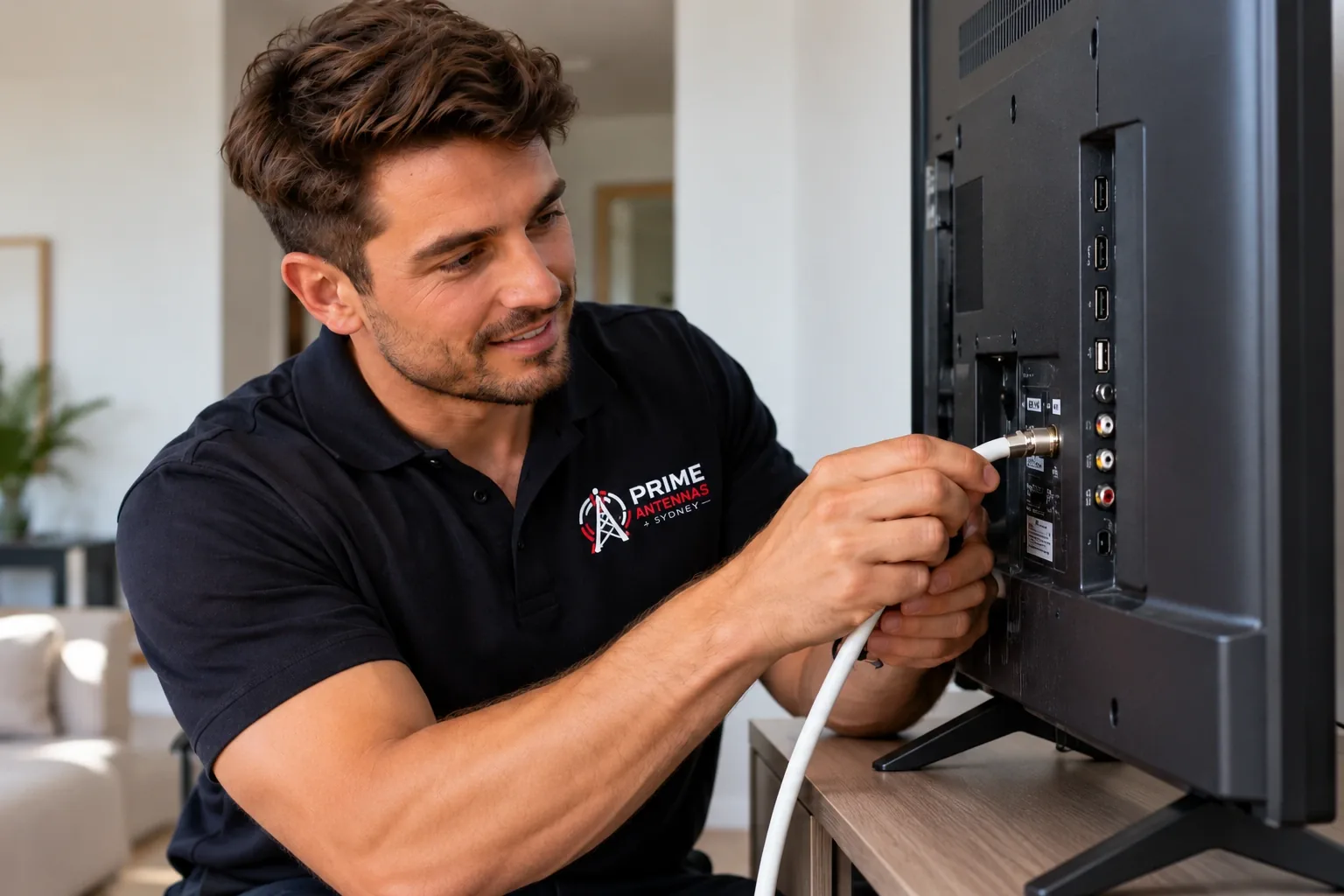
Safe checks you can do yourself
SafeWork NSW working-at-heights guidance
Does your Sydney location affect TV reception?
Yes, but suburb alone does not determine whether reception will be good or bad.
The exact address, terrain, surrounding buildings, transmitter and antenna installation all matter.
Eastern Suburbs & coastal Sydney
Salt, moisture and exposure can accelerate corrosion of exposed antenna hardware, connectors and cable.
Northern Beaches & exposed North Shore
Wind exposure can make secure mounting and correct antenna alignment particularly important.
Inner West, CBD & apartments
Dense development and shared master antenna systems can make reception faults more complicated than a single rooftop antenna issue.
Western Sydney
Distance, terrain and transmitter selection can influence which antenna type and position perform best at a particular property.
See the areas covered by Prime Antennas Sydney on the Sydney Service Areas page.
Repair the antenna or replace it?
Poor TV reception does not automatically mean the whole antenna system needs replacing.
Repair may make sense when
- the antenna is physically sound
- the alignment is incorrect
- a connector has failed
- one section of coaxial cable is damaged
- a splitter or wall plate is faulty
- an amplifier has failed
- the problem is a correctable distribution fault
Replacement may make sense when
- the antenna has substantial corrosion
- elements are broken or missing
- mounting hardware is badly deteriorated
- storm damage is extensive
- several parts of an old system are failing
- repeated repairs are becoming poor value
Age alone should not decide whether an antenna is replaced.
A physically sound older antenna may continue to perform correctly, while a poorly installed or heavily exposed newer system may fail sooner.
The more useful question is: what do the physical inspection and signal measurements show?
For more information about antenna installations and reception faults, see TV Antenna Installation & Repairs Sydney .
What does fixing TV reception cost in Sydney?
There is no accurate single price for every television reception fault.
The final cost can depend on the actual fault, roof access, building height, antenna condition, existing cabling, cable length, number of outlets, splitters, amplifiers and how much of the existing system can be reused.
| Type of work | General 2026 market indication |
|---|---|
| Basic signal diagnosis / simple fault visit | Around $90–$150+ |
| Antenna realignment or minor repair | Around $140–$340 |
| Connector, wall plate or local cable repair | Around $120–$300+ |
| New TV antenna supply and installation | Around $250–$680+ |
| Additional TV outlet | Around $120–$430+ |
| Difficult roof access, amplifiers or complex distribution work | Can be higher depending on the property and scope |
These figures are broad market indications rather than a Prime Antennas Sydney quotation.
Diagnosis matters because the cheapest correct repair may be much smaller than replacing the entire system.
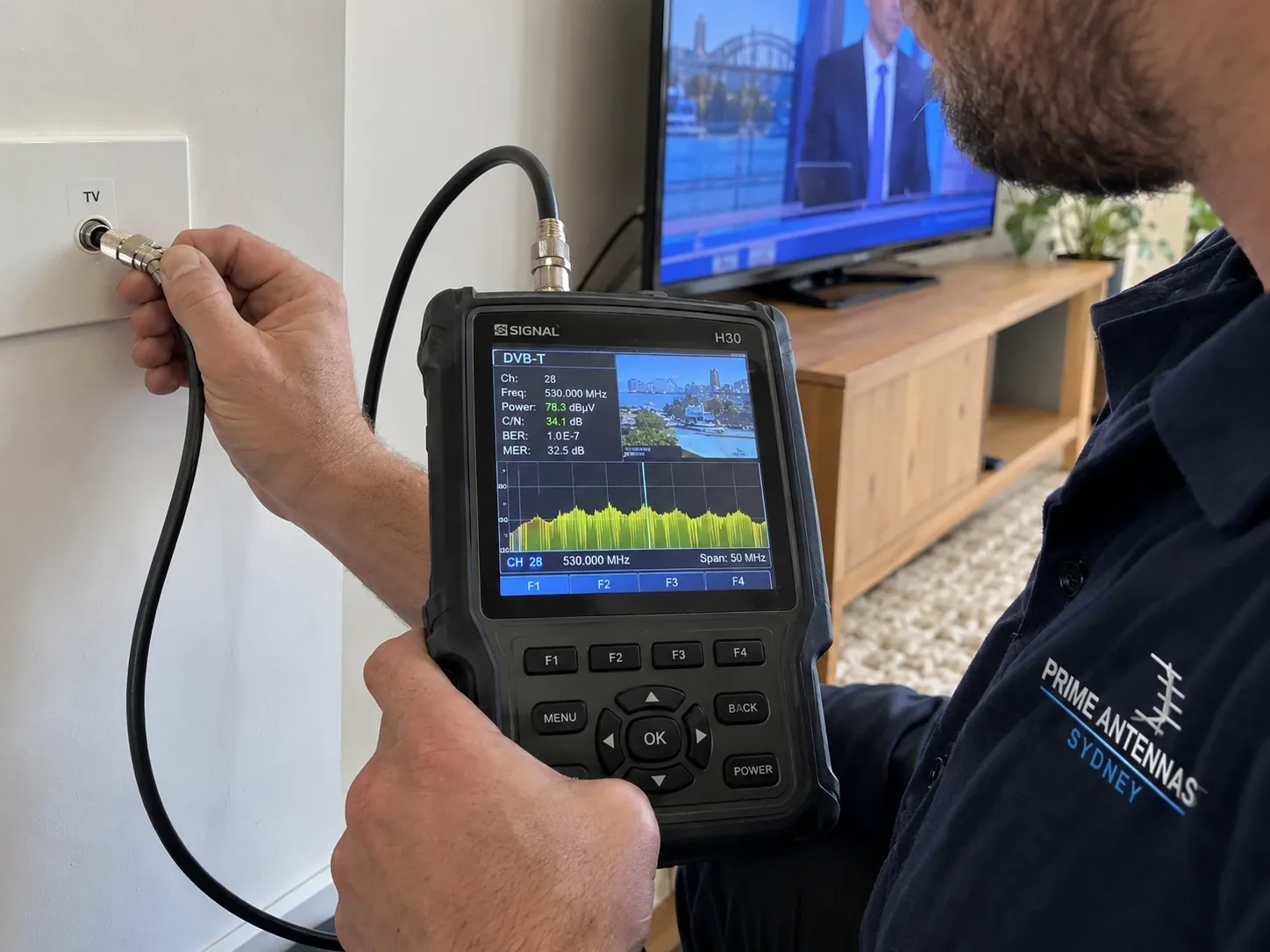
What should a proper TV reception diagnosis check?
Useful fault finding should go further than simply checking whether there is “some signal”.
Depending on the installation, testing may consider:
- signal level
- signal quality
- readings at the antenna
- readings at the television outlet
- cable losses
- connectors
- splitters
- amplifiers
- antenna condition
- antenna alignment
- interference
- correct transmitter selection
Testing at more than one point can help identify where the signal is being lost.
Example diagnosis
Good signal at the antenna + poor signal at the wall outlet:
The fault is more likely somewhere within the distribution system.
Poor signal at the antenna itself:
Attention moves towards antenna selection, alignment,
transmitter choice, interference or reception conditions.
Good signal at the wall outlet + problem on only one TV:
The television, fly lead or tuning becomes more likely.
Australian cabling requirements
TV antenna reception work and regulated telecommunications cabling should not be treated as exactly the same category.
Where work involves regulated customer communications cabling, Australia’s rules are specific.
The Australian Communications and Media Authority states that the Telecommunications (Cabling Provider) Rules 2025 apply to regulated customer cabling work.
Registered cablers must hold the appropriate registration and competencies, and applicable work must comply with relevant requirements and cabling standards.
Prime Antennas Sydney holds cabler registration A059596.
- ACMA — Cabling Provider Rules
- ACMA — Australian Cabling Standards
- ACMA — TV Reception Problems and Fixes
Why can TV signal drop out only at night?
Intermittent reception can be difficult to diagnose because a system may operate normally for most of the day.
Possible causes include marginal signal quality, electrical interference, equipment switching on at particular times, weather changes exposing a weak connection or intermittent amplifier faults.
If reception fails at a similar time each day, record which channels are affected and whether every television in the property experiences the same problem.
Why are only some channels missing?
Different television services use different broadcast frequencies.
A reception system that has deteriorated can therefore continue receiving some services while struggling with others.
Check whether the affected broadcaster has a known outage and confirm that the television is tuned to the appropriate transmitter.
If retuning restores the channels only temporarily and they disappear again, the underlying reception system should be investigated rather than repeatedly performing channel scans.
Do you actually need a TV signal booster?
Not necessarily.
An amplifier can be useful when there is a genuine need to compensate for distribution losses or when an otherwise suitable signal needs amplification.
It does not automatically fix antenna damage, poor alignment, water-damaged cable, corrosion, interference or incorrect transmitter selection.
Testing should come before amplification.
How long does a TV antenna last?
There is no reliable universal lifespan for every television antenna.
Service life depends heavily on antenna construction, mounting quality, connector weatherproofing, coastal exposure, wind, UV exposure, cable quality and installation workmanship.
Condition and measured performance are more useful than replacing an antenna simply because it has reached a certain age.
TV Signal Problems in Sydney: Quick Summary
If your TV is pixelating, freezing, losing channels or showing “No Signal”, the fault does not automatically mean you need a new antenna.The symptoms can help narrow down which part of the reception system should be checked first.
What you can safely check first:Confirm the television input, test another TV, inspect the indoor fly lead, check which channels are affected and use the Australian Government’s mySwitch service to confirm reception information for the address.
Repair versus replacement:Damaged connectors, cable faults, alignment problems, splitters and amplifiers can often be repaired without replacing the entire antenna.Replacement becomes more reasonable when the antenna or mounting system is significantly corroded, damaged or no longer performing reliably.
About signal boosters:An amplifier should not be the automatic first solution. Testing should establish why the signal is poor before amplification is added.
Cost:TV reception repair prices vary because the actual fault, roof access, cabling, antenna condition and distribution system differ between properties.
Safety:Indoor checks are reasonable, but climbing onto a roof to move or inspect an antenna creates a serious fall risk and should not be treated as basic DIY troubleshooting.